AUDITEDTRADER / STATEMENT RECONSTRUCTION
Reconstructing Trading Returns Around Deposits and Withdrawals
Reconstructing Trading Returns Around Deposits and Withdrawals; original source requirements and clearly bounded reconstruction education.
Reconstructing Trading Returns Around Deposits and Withdrawals
A statement-reading exercise that separates account growth, trading profit, external flows and the limits of an equity record.
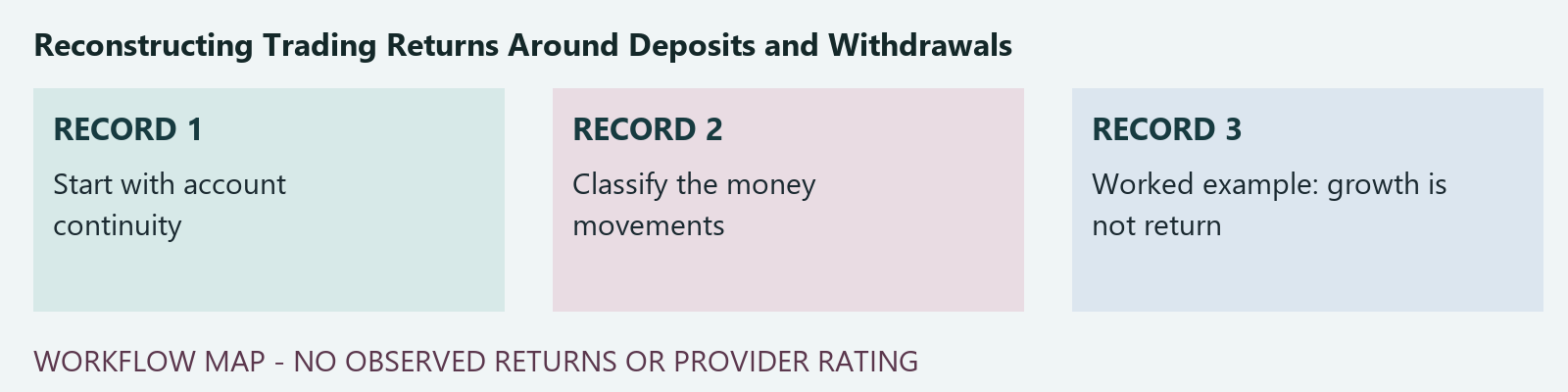
Start with account continuity
Put the account identifier, base currency and covered dates on the first working sheet. Join every statement page before examining the attractive return number. Distinguish an account transfer from a new trading account, and distinguish a broker export from a spreadsheet someone prepared later. Redacted identifiers can still preserve continuity through a stable reference. If a month or subaccount is absent, record the missing interval explicitly. A balance reconciliation for the available pages is a narrower accomplishment than verification of an uninterrupted track record.
Classify the money movements
Create separate columns for trading proceeds, fees, financing, dividends, deposits, withdrawals and internal transfers. Keep the broker description next to your classification so another reader can challenge it. Opening equity plus all economic changes should reconcile to closing equity under the stated currency and valuation convention. Do not classify a deposit as a gain merely because the account became larger. A discrepancy belongs in the reconciliation log; it is not solved by assigning the residual to trading profit or by silently dropping an inconvenient transaction.
Worked example: growth is not return
Invent an account with opening equity of 10,000 units. Before any trading gain, its owner deposits 5,000, making 15,000 available. Trading then adds 1,500 and the account closes at 16,500. Account growth measured against the original 10,000 is 65%, but that includes the deposit. For this deliberately simple boundary-timed example, trading return on the 15,000 capital available during the trading interval is 10%. Moving the deposit into the middle of the interval would require intermediate valuations or a stated approximation; subtracting cash flow alone would not identify a unique time-weighted return.
Choose the return object before calculating
Decide whether the question concerns the strategy through time or the investor experience with a particular sequence of cash flows. Do not switch between those objects because one produces a higher number. Record the valuation points and the handling of fees, taxes, financing and currency conversion. The GIPS standards are a primary reference for performance-reporting concepts, but this worksheet does not claim GIPS compliance, a formal audit or professional assurance. Such claims require their own applicable scope, records and qualified process.
Rebuild equity, not only closed balance
A closing balance can look healthy while an open position has a large unrealised loss. Ask for the available equity observations, open-position valuations and their timestamps. Publish the frequency of the reconstructed path and identify gaps where intraday stress cannot be seen. A monthly sequence cannot certify the absence of a short-lived drawdown. Keep broker fills distinct from hypothetical research entries; a successful reconciliation of cash movements does not authenticate the research fill convention or show that every subscriber received the same trade.
Publish a bounded reconciliation
The deliverable should identify the account period, currency, source files, classifications, formulas, unresolved amounts and review status. Mark each figure as supplied or reconstructed. Preserve the original source and a separate correction record when a later statement arrives; overwriting history makes the calculation harder to inspect. If no underlying statements were provided, publish the procedure and the evidence request rather than an invented audit result. This exercise creates a reusable method, not a new audited trader entry or confirmation of someone else's headline return.
Decision record
| Question | Record to retain | Decision boundary |
|---|---|---|
| Account identity | Dated source pages with a stable account reference | Partial continuity cannot support a complete-period claim |
| External flow | Amount, currency, settlement time and classification | A deposit is capital movement, not trading profit |
| Open exposure | Position valuations and equity observation frequency | Balance-only records leave drawdown limits unresolved |
| Published return | Formula, inputs, costs and reconciliation exceptions | Withhold a reconstructed figure when its inputs are missing |
Blank working record
The worksheet contains column headings only. Enter your own dated observations, keep absent evidence marked unknown, and do not treat the file as certification.
 Download worksheet (CSV)
Primary references
These documents support mechanisms and source definitions, not a tested trading result or a recommendation. Accessed 9 October 2026. The decision workflow and invented examples above are editorial exercises.
Keep reading
Publication methodology | Working glossary | Source and correction policy
Inspect a complete invented movement register
The original blank worksheet remains available. The new teaching packet adds six full calculation rows and the individual movement events behind their totals. It includes a transfer pair, different income and charge fields, unrealised marks and a deliberately unexplained closing difference.
This allows monetary reconstruction without pretending the examples are actual broker observations. The missing source interval also shows why agreement among supplied totals cannot establish a complete financial record. No new personal or model return is inferred from these rows.
Separate chronology from the accounting total
A monthly identity can reconcile without showing when a deposit arrived relative to investment movements. A percentage-return method may need valuations around those flows. The monetary bridge intentionally avoids producing a return percentage from incomplete timing.
The period mapper checks inclusive calendar labels and missing states, while the source dossier records provenance and scope. These complementary tools answer distinct questions. Their software fixtures are not independent financial samples and do not establish a completed assurance review.
Complete authored statement packet | Monetary reconciliation bridge | Calendar coverage map